Tag: poetry

  • More Thoughts on Rollo Dilworth’s Weather: Stand the Storm

    Professor Rankine wrote a powerful poem that I posted here. As we continue to rehearse Dr. Dilworth’s setting for the poem, I discover more about how the music brings out the further meaning of the poem.
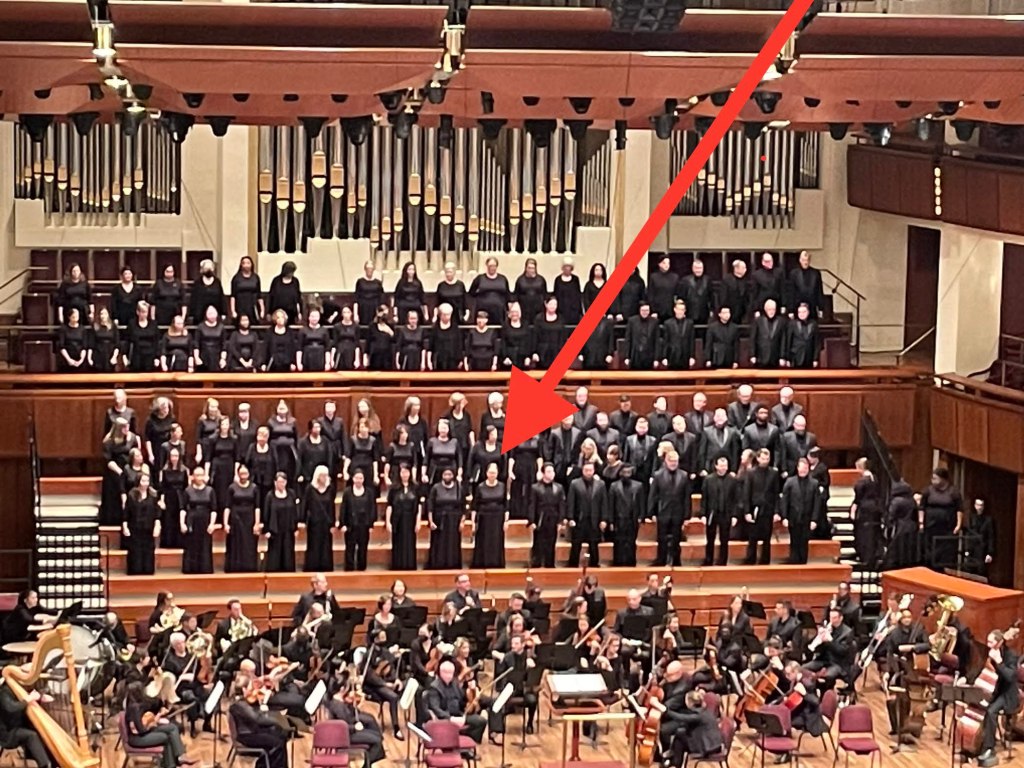
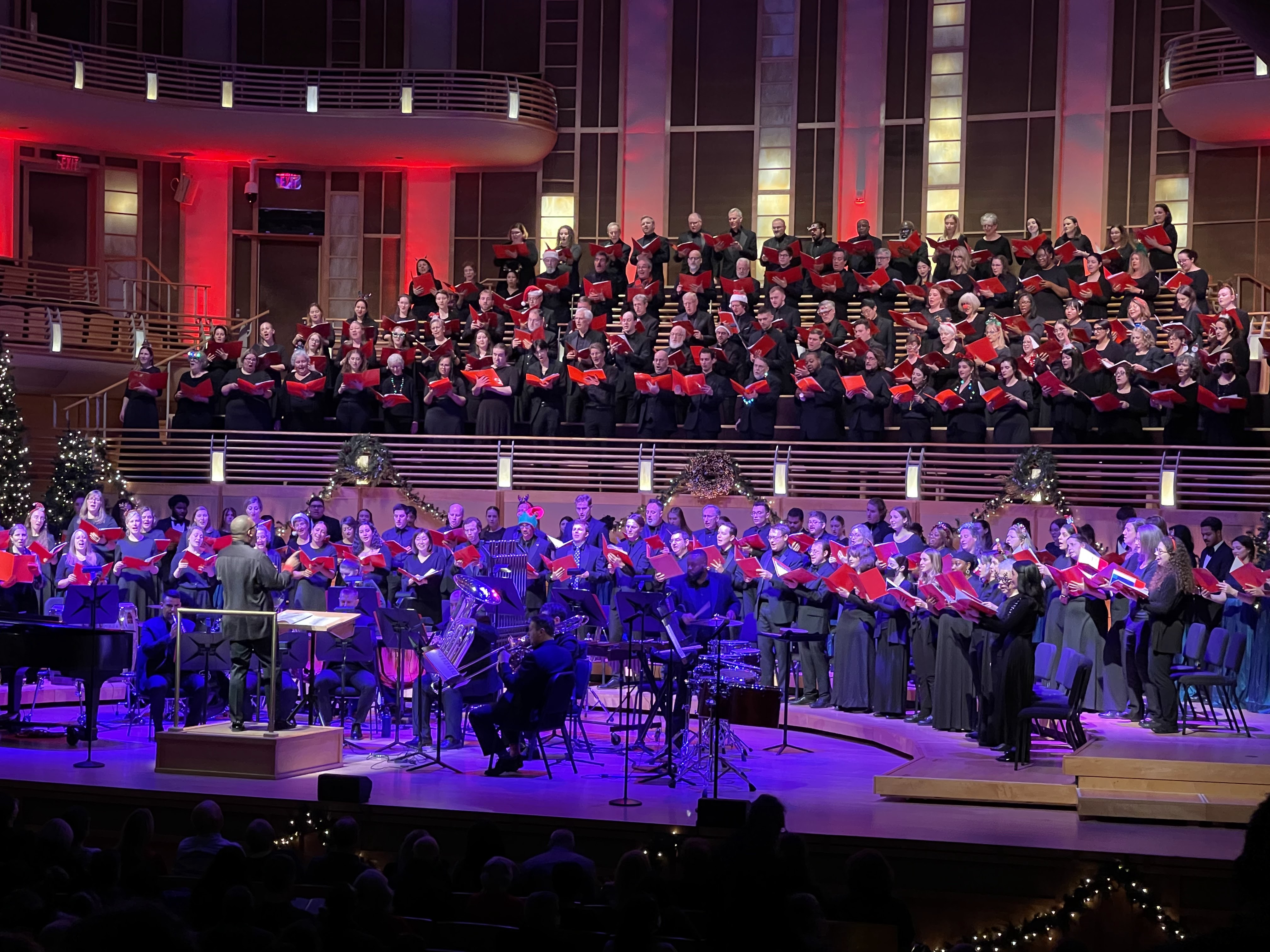
    The Washington Chorus, Dr. Eugene Rogers, artistic director

    The poem starts in the peaceful environment of a university archive (“On a scrap of paper in the archives is written I have forgotten my umbrella.”) and the music is tranquil yet with a surprisingly urgent beat. Next it discusses the confusion of information that accompanied the start of the pandemic and the music takes on swirls and yet is in a persistent twelve-bar blues setting. Then for the devastating stanza “Six feet under for underlying conditions. Black” there is a dark and dissonant chord on the word “Black”.

    The most poignant repetitions are “eight minutes forty-eight seconds” over and over, then leading to “I can’t breathe” over and over. The music drops out of the twelve-bar blues to an urgent, rattling dissonance and confusion the concludes with repetitions of “in extremis.” Was the poet also making a reference to extremism here? That could be a valid interpretation.

    Then the music begins a march to accompany “whatever contracts keep us social compel us now to disorder the disorder,” perhaps inviting us to march in protest.

    The piece concludes with a reinstatement of tranquility as the poet observes “There’s an umbrella by the door, not for yesterday but for the weather that’s here” and builds to the sound of strength as the chorus declaims “We are here for the storm that’s storming because what’s taken matters.”

    This is why I love music so much, and choral singing in particular. It adds a drama to the words that is unmatched.
  • Rollo Dilworth’s Setting of Claudia Rankine’s Poem

    Dr. Dilworth has set Professor Rankine’s extraordinary poem to a thought-provoking piece of music that is both lyrical and dissonant. His title for the work is Weather: Stand the Storm, which captures both the title of the poem and the title of the spiritual (Stand the Storm) that is the central melodic theme.

    Dr. Dilworth wrote an extensive set of performance notes for his piece, which is something I really appreciate as a choral singer. I’ll mention just a few items out of the many elements he put into the music.

    The “George Floyd” Motives are different combinations of using the notes G and F. These notes are only one step (whole step) apart so they can create dissonance when they part of a chord and jagged leaps when they are part of a progression. These musical ideas generate exceptional poignancy regarding the death of Mr. Floyd.

    There are many deliberate numerical references in the score but I’ll just discuss one here, and that is 8:46. This was the amount of time that George Floyd was pinned down. Dr. Dilworth therefore uses 8/8, 4/4, and 6/8 time signatures to embed those numbers in his work.

    The section that has the text “Just us and the blues kneeling on a neck with the full weight of a man in blue.” is set to 12-bar blues.

    If you are interested in the complete performance notes you might be able to buy a copy of the piano reduction choral score from his publisher, Hal Leonard, LLC. It is ISBN 978-1-70518-585-8.

    Meanwhile, here is a link to a performance on Youtube that I think is particularly good: https://youtu.be/38drTqFhd6w. If you are in the Washington DC area, The Washington Chorus will be performing this work live at The Music Center at Strathmore on March 15th, 2025 at 7:30pm. You can get tickets here: https://thewashingtonchorus.org/stand-the-storm.

  • Power of Poetry

    The best poets find a path to unlock the power of language to create beauty and to tell some of the deepest truths of human existence.

    Wilfred Owen is one of my favorite poets. His heart-wrenching poems, written from the trenches of World War One, flash in mournful beauty as they decry the folly, pity, and horror of war. This poem uses imagery from the crucifixion and also contrasts the war with Christ’s teaching to love one another, including one’s enemies.

    Another thing to note is that it is set in war-ravaged France, where there were often crosses set up at cross roads. In this instance the cross has been damaged and is missing an arm (“He too lost a limb”).

    Wilfred Owen was tragically killed just one day before the armistice.

    At a Calvary Near the Ancre

    One ever hangs where shelled roads part.

    In this war He too lost a limb,

    But his disciples hide apart;

    And now the solider bear with him.

    Near Golgotha strolls many a priest,

    And in their faces there is pride

    That they were flesh-marked by the Beast

    By whom the gentle Christ’s denied.

    The scribes on all the people shove

    And bawl allegiance to the state,

    But they who love the greater love

    Lay down their life; they do not hate.

    In a later post I’ll talk about the Wilfred Owen poems that Benjamin Britten selected for his choral masterpiece War Requiem.

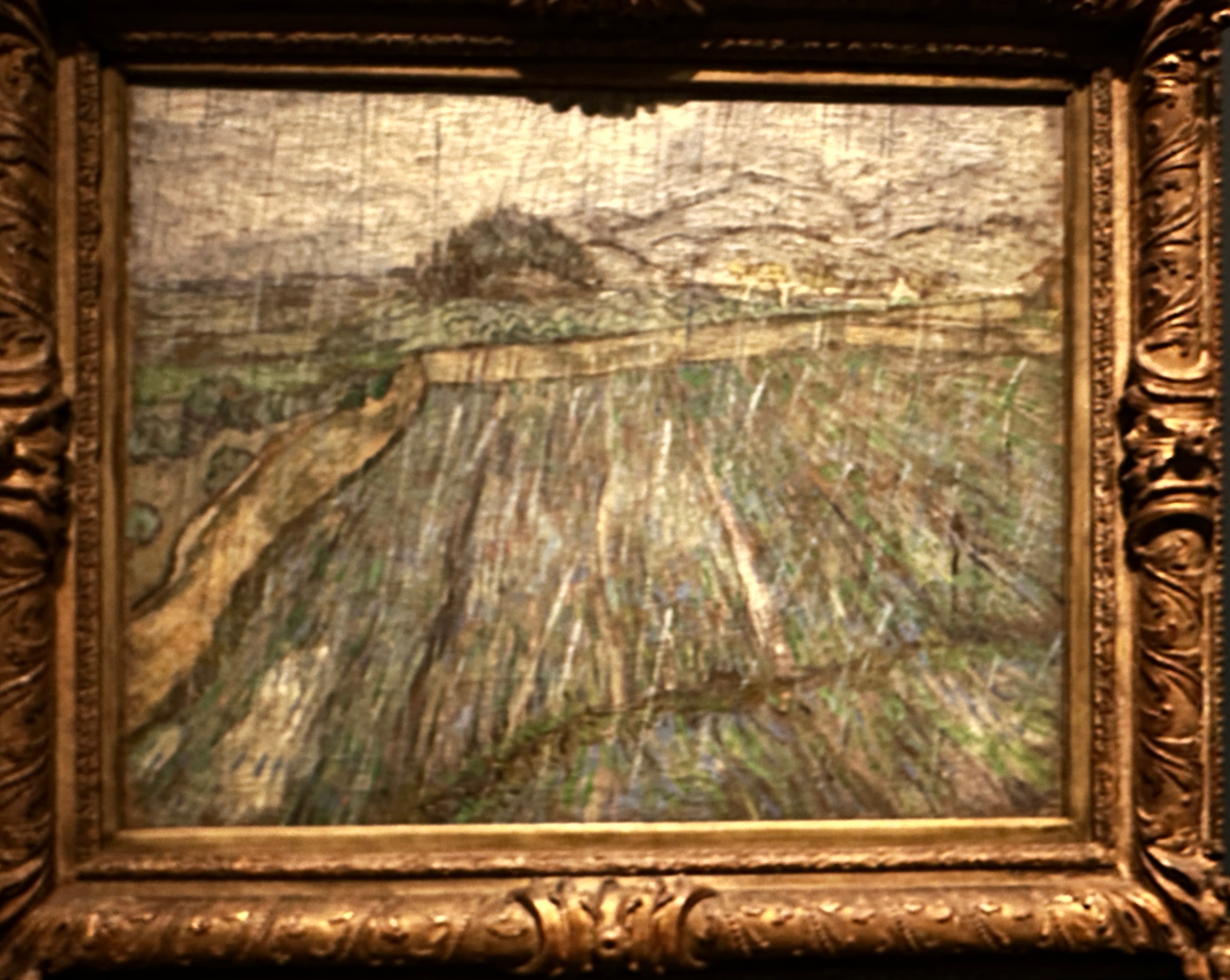
  • Rain by Van Gogh

    I was surprised by this painting because the colors are more muted than I expect from Vincent Van Gogh. The subject matter, rain, is difficult to capture well in painting, yet he has gotten it perfectly. Drops of rain have to capture light just right in order for our eyes to see it. Oftentimes I look out the window to see if it is raining or not, but it takes a moment for my eye to adjust and to see the rain. That is why I think this painting is so marvelous; it has caught that moment when your eye sees the rain drops.

    I like how the storm has muted the colors in the scene. I also note that although Van Gogh uses the traditional vanishing point in this painting, he is more dependent on shape and form to suggest depth rather than using haze or dimness. As ever, I love the strong brush strokes with large amounts of paint applied to the canvas.

    Thank you, Van Gogh, for giving me such a thrill of pleasure!

    Rain, Vincent Van Gogh. Philadelphia Museum of Art, Philadelphia, PA